Who Cleans Hämeenkatu on Sunday Morning?
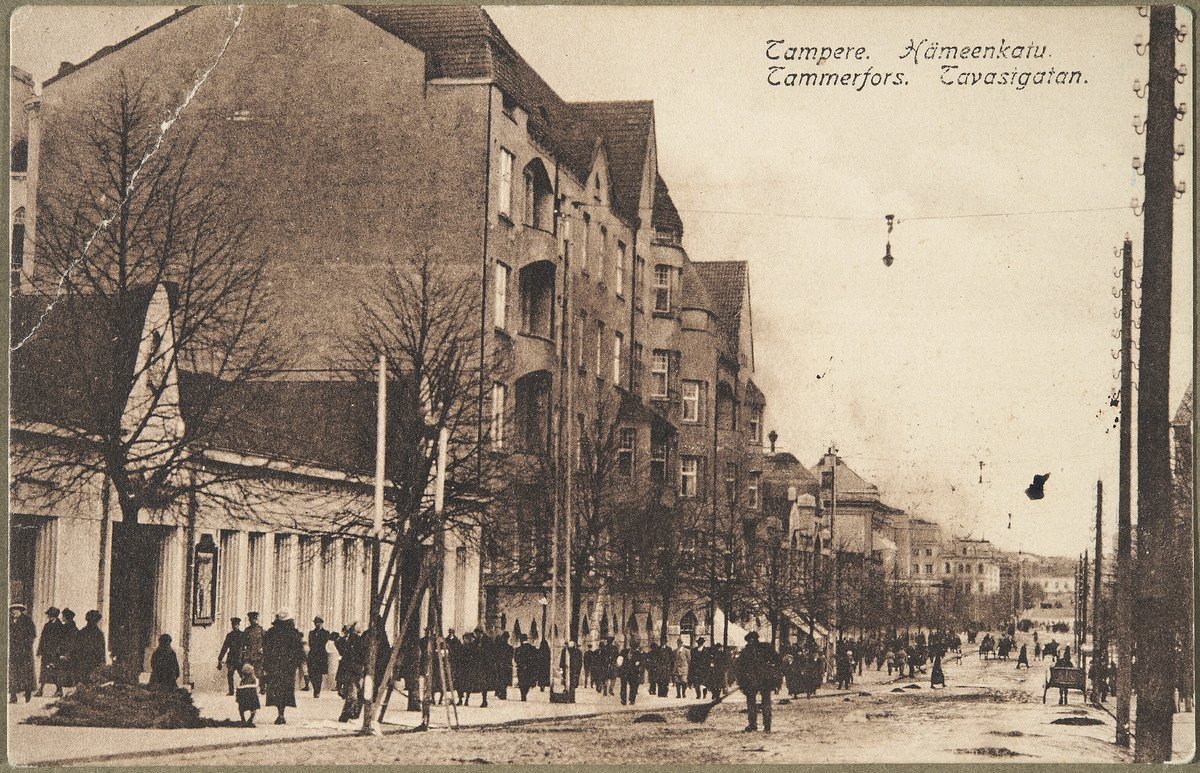
Photo: unknown photographer / Finnish Heritage Agency, Historical Picture Collection, CC BY 4.0. Pedestrians and a street sweeper on Hämeenkatu, no later than 1921.
Every Saturday and Sunday morning, Hämeenkatu, the main street of Tampere, looks as if a civil war had just rolled over it. The street is awash with litter, broken glass, excrement and blood.
This is of course a sign of healthy and lively commercial activity on weekend nights, which is exactly what a city centre needs.
But on Saturday and Sunday afternoons the centre is also full of people with money and a desire to spend it, such as families with children. For them, the remains of the previous night’s commercial activity are a repulsive and sometimes even frightening experience. When you’re steering a pram between shards of glass and puddles of vomit, you start to wonder whether you should have just driven to a big-box retail park by the motorway.
The city belongs to everyone
The city belongs to everyone, and that’s how it should be. We need and want both nightlife and daytime life in the centre. I’m not suggesting that bars should close at midnight or that Hämeenkatu should be turned into a museum.
What I am suggesting is that the right to keep an audience in a state of intoxication where the city inevitably takes collateral damage should come with responsibility for the results.
Everyone benefits from a clean and safe street, nightlife operators included. Nobody wants to queue for a bar on a street that looks like a landfill. The people on Hämeenkatu share an interest. All they need is a shared kitty.
Who is responsible for the street today?
The law is surprisingly clear. Under the Finnish Act on Street Maintenance and Cleaning, a property owner is responsible for keeping the street clean along their plot.S1 On a tram street like Hämeenkatu, that responsibility extends to the outer edge of the pavement. The city and the Tampere tramway company look after the carriageway and the tracks.S2
So, legally, the broken glass and vomit on the pavements are the problem of the housing companies and property companies along the street. There are about 40 of them.A3
The city’s cleaning classification maps also show how clean the street is supposed to be.S3 Most of Hämeenkatu’s carriageway and pavements are in class P1, where the need for cleaning is checked daily from Monday to Friday and on Saturday or Sunday. The stretch at the central square (Keskustori), the Hämeensilta bridge and the first block east of the bridge are in the top class P1s, which is cleaned every day. The classification also applies to the pavements that the properties are responsible for.
On paper, then, Hämeenkatu must be cleaned on at least one weekend day. In practice, though, it makes little sense for a single housing company to book a cleaner for 5 am on a Sunday to sweep thirty metres of pavement.A6 Sunday work costs double pay,S4 and the cleaner has to travel there for thirty metres. So the mess waits for office hours.
The city does weekend cleaning in its own areas, but mainly in summer. Under the current city-centre cleaning classification, weekend cleaning in the most important areas takes place from 1 May to 31 August.S2 The list of areas that are machine-cleaned at weekends includes Keskustori, Koskipuisto park, the railway station and a few other squares, but not Hämeenkatu. In winter, the city mostly picks up the largest pieces of litter and empties bins “to the extent necessary”.
So the problem isn’t that nobody is responsible. There are two problems.
The first is that the responsibility has been chopped into forty pieces that are too small.
The second is timing. The mess is at its worst on Saturday and Sunday mornings, and that’s exactly when cleaning is most expensive. Work done at 5 am on a Sunday earns a night-work supplement and double pay. At 8 am on Monday the same work costs half as much,A1 but by then the mess has already ruined two days.
The proposal: a shared cleaning crew
Hämeenkatu buys a shared cleaning crew for two mornings a week, Saturday and Sunday. The crew works the street from end to end, from the railway station to Hämeenpuisto, before the first customers arrive.
The bill is split three ways, a third each:
- The properties, because keeping the pavements clean is already their legal responsibility. A shared crew is cheaper for them than each taking care of its own stretch.
- The businesses on the street, because their customers make the mess and their customers also benefit from a clean street.
- The city, because a clean main street is the whole city’s calling card, and the carriageway is its responsibility anyway.
The idea isn’t new. Elsewhere in the world, arrangements like this are called Business Improvement Districts. In a BID, the businesses or property owners in an area pay a shared levy that funds cleaning, security or marketing on top of the municipality’s basic services.S9 As far as I know, Finland has no equivalent statutory model, but nothing prevents a voluntary agreement.
How much would cleaning cost?
Picture a crew of four cleaners and a small suction sweeper with a driver. The crew starts at about 5 am and finishes by 8.A2
| Cost item | Saturday morning | Sunday morning |
|---|---|---|
| 4 cleaners × 3 h | €540 (€45/h) | €900 (€75/h) |
| Suction sweeper and driver × 3 h | €360 | €390 |
| Waste, needles, detergents etc. | €100 | €100 |
| Total | €1,000 | €1,390 |
Sunday morning costs more because Sunday work earns double pay plus a night-work supplement. One weekend comes to about €2,400, which is about €10,400 a month and about €125,000 a year (excluding VAT).
These figures are a rough estimate.A1 A request for tenders would give the exact price, but the order of magnitude is this: ten thousand a month, not a hundred thousand.
In the three-payer model, each party’s share is about €3,450 a month.
The properties’ share
Among the properties, the share is divided according to how long a stretch of pavement each is responsible for. The law already uses the same basis.S1
On both sides of Hämeenkatu together there are an estimated 1,500 metres of private property frontage, excluding side streets, bridges, parks and the city’s own properties.A4 The properties’ share would therefore be about €2.30 per metre of frontage per month:
| Property | Frontage | €/month |
|---|---|---|
| Ordinary apartment block | 30 m | €69 |
| Large commercial or bank building | 60 m | €138 |
| Department store block | 100 m | €230 |
For a housing company with forty apartments, €69 a month means less than two euros per apartment. That’s less than a cup of coffee.
The businesses’ share
Among the businesses, a fair formula makes those who cause more mess pay more. But it’s hard to measure where litter comes from, so we need an easily verifiable metric. I propose opening hours:
Every business gets one base share. On top of that, it gets one share for every hour it is open after 10 pm on Friday and Saturday nights.
A flower shop that closes at six therefore pays one share. A nightclub open until 5 am is open seven hours after ten on two nights, so it pays 1 + 14 = 15 shares. The formula is transparent, opening hours are public, and nobody has to count cigarette butts.
I went through the restaurants, bars and fast-food places on Hämeenkatu on Google Maps and checked their weekend opening hours.S8 The result:
- 18 bars, pubs and nightclubs. Nine of them are open until at least 4:30 am on Friday and Saturday nights.
- 10 fast-food places. Six of them are open until 5 am or around the clock. When the bars close, the queue moves to the kebab shop.
- 8 restaurants and 5 cafés that close in the evening.A5
- About 64 shops and service businesses, according to the city’s vitality survey.S5
That makes about 105 businesses and 394 shares. One share costs about €8.80 a month:
| Business (Fri–Sat hours) | Shares | €/month |
|---|---|---|
| Nightclub or kebab-pizzeria, open until 5 am | 15 | €131 |
| Pub, open until 2 am | 9 | €79 |
| Wine bar, open until 1 am | 7 | €61 |
| Restaurant, open until 11 pm | 3 | €26 |
| Café or shop, e.g. a flower shop | 1 | €9 |
By group, bars and nightclubs would pay more than half of the businesses’ share, fast-food places a fifth, and shops and services together a sixth. That matches fairly well whose customers’ leftovers are being swept up in the morning.
The city’s share
The city’s share would be about €41,000 a year. The city spends a lot of money measuring and developing the vitality of the centre, and its own reports return again and again to the idea that the centre has to hold its own against shopping malls.S5S6 Compared to that, the sum is a rounding error.
The city has also already recognised the problem. During the consultation on the 2023 cleaning classification, the Pakkahuone square was added to the areas machine-cleaned at weekends, because the people who gather there mess up the steps every day.S7 Hämeenkatu deserves the same treatment, all year round.
The city’s share also makes the model politically sustainable. With the city on board, the model isn’t just another fee for property owners and entrepreneurs. It’s a joint project in which everyone has something at stake.
Fair for everyone
To sum up: ten thousand euros a month sounds like a lot, but split three ways and among nearly 150 payers it comes to:
- about €70 a month for an ordinary housing company
- €9 a month for a shop or café
- about €130 a month for a nightclub open until 5 am
- about €3,450 a month for the city.
In return, Hämeenkatu would be clean every Saturday and Sunday morning, all year round.
The broom is only the beginning
A clean street is reason enough on its own. But the most interesting thing here isn’t the broom. It’s the table that the street’s stakeholders would have to sit around.
Hämeenkatu has about 40 properties and a hundred businesses sharing the same street. Once they have agreed on who pays what and who orders the cleaners, they will also have built something more valuable: an organisation with a kitty, a membership list and a way to make decisions.
After that, the next steps become much easier:
- Shared Christmas lights and summer flowers that run from one end of the street to the other instead of stopping where one property’s plot ends.
- Putting empty premises to use. The city’s survey counted eleven empty commercial premises on the street.S5 Properties and entrepreneurs could together offer them to pop-up shops, exhibitions or restaurant experiments until a permanent tenant is found.
- Shared events, for example a monthly Hämeenkatu Saturday when shops stay open longer and there’s something happening on the street.
- Shared marketing. Shopping malls market the whole centre together. Hämeenkatu is the best-known street in Tampere, and it could be marketed the same way, as one destination.
- Safety at night. The same group that agrees on morning cleaning can also agree on shared security staff or on how to ease the crowds at bar closing time.
- One voice towards the city. When the city plans its next street renovation, event or cleaning classification, it would have a partner that speaks for the whole street.
Cleaning and security are among the most typical tasks of Business Improvement Districts, but most of them also do marketing, events and public space improvements.S9 Hämeenkatu is already the main street of Tampere. Organised cooperation could also make it the most desirable address in the city, a place people come to with their children on Saturday and not just on Friday night.
Next step
This doesn’t need a change in the law, a council motion or a ten-year study. It needs one active person to bring the street’s properties and entrepreneurs to the same table, one request for tenders to cleaning companies and one email to the city’s maintenance department.
If you represent a property or business on Hämeenkatu and the idea interests you, get in touch. Let’s make this happen before the next family decides the retail park is nicer after all.
Sources
Markers S refer to sources and markers A to my own assumptions and estimates. Sources were checked on 8–9 November 2026. Most sources are in Finnish.
- S1 Act on the Maintenance and Cleaning of Streets and Certain Public Areas 669/1978 (in Finnish). The property owner is responsible for cleaning the street area along their plot.
- S2 City of Tampere: City-centre cleaning classification (page updated 20 October 2025) and City-centre cleaning classification 2023 (pdf): division of responsibility on the tram corridor (section 1.3), winter cleaning (p. 3), classes P1s and P1 (section 3.4) and weekend cleaning areas (section 3.7). The classification is still in force, and no newer version has been published.
- S3 City of Tampere: pavement cleaning classes and responsibilities on maps, western city centre (appendix 5.1) and eastern city centre (appendix 5.2).
- S4 Working Hours Act 872/2019, section 17 (in Finnish): Sunday work is paid at a 100% premium.
- S5 City of Tampere: Vitality survey results H2/2022, special review of Hämeenkatu (pp. 45–47). In autumn 2022 the street had 121 street-level commercial premises: 51 shops open on Saturdays, 45 restaurants or cafés, 13 businesses open on weekdays only, 11 empty premises and 1 under renovation.
- S6 City of Tampere: Commercial vitality of central Tampere 2026.
- S7 City of Tampere: City-centre cleaning classification 2023, summary of comments, comment 8.
- S8 Google Maps and the businesses’ own websites and social media profiles, checked on 8 November 2026. Businesses with a Hämeenkatu address are included. Businesses inside the Market Hall (Hämeenkatu 19) and inside department stores are excluded, as in the city’s vitality survey.
- S9 Wikipedia: Business improvement district.
- Photo: Pedestrians and a street sweeper on Hämeenkatu, Finnish Heritage Agency, Historical Picture Collection (HK19700524:323), CC BY 4.0.
Assumptions and estimates
- A1 The hourly rates are my own estimates: a cleaner at €45/h on Saturday morning and €75/h on Sunday morning, a sweeper with driver at €120–130/h, and €100 per morning for supplies and waste. The estimate is based on a cleaner’s hourly wage of about €13–16 (industry job ads), the night-work supplement, the Sunday premium (S4) and the employer’s overheads and margin. The real price will only be known after a request for tenders.
- A2 The crew size (4 cleaners and a machine) and duration (3 hours) are assumptions that I estimate to be enough to cover a street about a kilometre long.
- A3 The number of properties (about 40) is an estimate based on the list of buildings in the Finnish Wikipedia article on Hämeenkatu. The list has about 41 buildings, a few of which belong to the city, such as the City Hall and the Market Hall.
- A4 The length of private property frontage (about 1,500 m) is an estimate: both sides of the street, about 2 × 1,000 m, minus side streets, the Hämeensilta bridge, parks, Keskustori and the city’s properties. The land register would give a more precise figure.
- A5 Restaurants are assumed to close at about 11 pm and cafés before 10 pm. For a few bars and fast-food places, Friday or Saturday hours could not be confirmed and were estimated from the other days. The number of shops and services (64) is the city’s 2022 figure (S5), not my own count.
- A6 That the properties don’t clean the pavements on weekend mornings because of the cost is my own reasoning. I have not looked into the properties’ actual cleaning practices.